
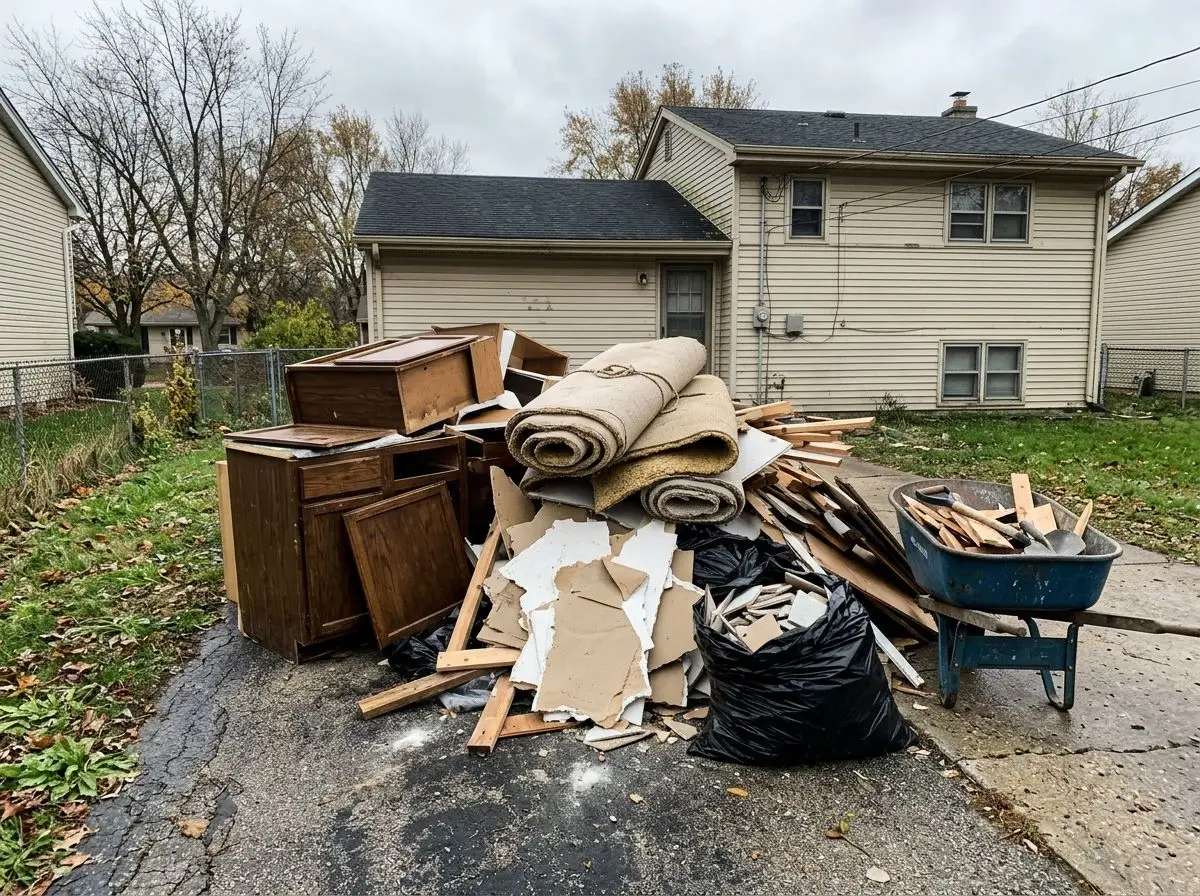
What to Do With Flood-Damaged Belongings in Rockford
Updated
Get a free quote
A local crew replies with a price. Nothing is booked until you say yes.
Rather talk? Call (815) 420-4153 or text us.
Short answer
Part of Garage and Basement Cleanouts.
Rockford floods, and basements take it first
On July 13 and 14, 2024, two nights of storms dropped as much as 6.9 inches of rain just east of downtown Rockford, with a second round of up to 3.6 inches the next night (National Weather Service). Basements across the city took on water, and the city put out a flooding FAQ on what to do with the trash. The city's own pages say floodplains along its streams and rivers are "intended to flood" (Rockford stormwater page), and along Keith Creek the city and the Rockford Local Development Corporation have bought and demolished more than 115 properties and relocated the residents to restore the floodplain (2025 Annual Report). In a city whose median home was built in 1963, a flooded basement usually holds decades of stored things.
Before anything goes: photos, a list and samples
The worst thing you can do for an insurance claim is clear the basement before anyone sees it. The City of Rockford's flooding FAQ told residents to report the damage to their insurer, take pictures, list everything damaged or destroyed and keep receipts for cleanup and repairs, since those records matter if state or federal help becomes available (Rockford flooding FAQ). FEMA's flood insurance guidance goes further (FEMA, file your claim):
- Photograph and video the damage, including the items you plan to throw out, before moving anything.
- Show the water line, inside and outside.
- Photograph the make, model and serial number of washers, dryers, water heaters, TVs and computers.
- Keep swatches of carpet, flooring, wallpaper and drapes for the adjuster.
Once that is done, the clock matters more than anything else.
The 24 to 48 hour rule
The US EPA says to assume mold is growing if the home and its contents were not dried within 24 to 48 hours, and to throw away materials that soak up a lot of water and cannot be cleaned and dried (EPA flood cleanup). The CDC's list of things to throw away if you cannot clean or dry them quickly is specific: mattresses, carpeting, carpet padding, rugs, upholstered furniture, cosmetics, stuffed animals, baby toys, pillows, foam-rubber items, books, wall coverings and paper products, plus drywall and insulation that floodwater or sewage reached (CDC).
Keep or toss: a quick sort
| Item | Usually | Why |
|---|---|---|
| Mattresses, pillows, upholstered couches and chairs | Toss | Porous; on the CDC's throw-away list |
| Carpet and pad, rugs | Toss, after a photo and a swatch | Porous; FEMA asks for swatches |
| Drywall and insulation that got wet | Cut out and toss | CDC and EPA both say discard |
| Books, papers, cardboard boxes | Toss, unless irreplaceable | Paper products are on the CDC list |
| Washer, dryer, freezer, water heater | Photograph serial numbers, then a technician decides | FEMA wants the make, model and serial |
| Furnace | Do not restart it yourself | The city FAQ says to have a professional inspect it |
| Metal, glass, hard plastic | Usually clean and keep | Non-porous items can be cleaned |
How Rockford handled flood trash in July 2024
After the 2024 floods the city suspended its set-out ordinance for the weeks of July 15 and July 22 so residents could put flood debris at the curb before normal collection, picked up on the regular garbage day. It asked residents to fill the city-issued 95-gallon cart first, then standard cans, and allowed bulk items like furniture, carpet and appliances that would not fit, with some restrictions (Rockford flooding FAQ). Storm branches went out with yard waste in bundles no more than 4 feet long by 2 feet across, with limbs over 4 inches thick refused.
That was a one-time measure. After a future flood, watch the city's site for a notice like it. Without one, the normal limit applies: about 3 cubic yards of garbage and bulk per home per week (Rockford bulk item collection), and building and remodeling materials are not taken at the curb (Rockford weekly garbage). Wet drywall is remodeling debris; see getting rid of remodeling debris. Yard rules are in the yard waste guide.
Appliances and chemicals that got wet
A flooded fridge or freezer still falls under the Illinois white goods rule: the refrigerant and certain parts have to come out before it is landfilled (415 ILCS 5/22.28), and Rockford's curb takes one only with a technician's certificate attached (Rockford bulk item collection). Appliance removal covers the options. Paint cans, pool chemicals and cleaners that sat in floodwater go to the household hazardous waste site, not the trash (Rockford household hazardous waste).
Getting a wet basement emptied
Soaked carpet, a waterlogged sectional and boxes of wet paper are heavy, and wet drywall is heavier still. A crew can carry it up the stairs and load it in one visit once you have your photos, so it is out before the smell sets in. That is a basement cleanout, priced by how much of the truck it fills: national guides put a half load at $200 to $400 and a full load at $400 to $800, with the rest on the cost page. Mold growth and sewage cleanup are a remediation job, not a haul-away; get that handled first if you see it.
More on junk removal in Rockford, IL: prices, the process and what is covered.
Sources: City of Rockford, Weekly Bulk Item Collection; City of Rockford, Weekly Garbage Collection; City of Rockford, Household Hazardous Waste Disposal; 415 ILCS 5/22.28, white goods; National Weather Service, The July 13-14, 2024, Rockford Flash Floods; City of Rockford, flooding FAQ (July 2024); City of Rockford, Stormwater and flooding around your home; City of Rockford, 2025 Annual Report; FEMA, file your flood insurance claim; US EPA, flood cleanup to protect indoor air; CDC, natural disaster and severe weather safety
Want a price for your own place?
Call, text, or send the form. You get a written price back before anything is scheduled.
Quick answers
Should I throw away things from a flooded basement before the adjuster comes?
Photograph and video everything first, including what you plan to throw out, and keep carpet and flooring swatches. FEMA says to document damage before moving or discarding items; once that is done, porous items can go so mold does not spread.
What should be thrown away after a flood?
The CDC lists mattresses, carpeting and pad, rugs, upholstered furniture, pillows, stuffed animals, foam items, books and paper products if they can't be cleaned and dried quickly, plus drywall and insulation that floodwater reached.
How long do I have before mold grows?
The US EPA says to assume mold growth if the home and its contents were not dried within 24 to 48 hours. Dry what you can keep and get the soaked porous items out.
Does Rockford pick up flood debris?
After the July 2024 floods the city suspended its set-out rule for two weeks and took flood debris on the regular garbage day, carts first. Outside an announcement like that, the normal limit of about 3 cubic yards a week applies and remodeling materials are refused.
How much does it cost to empty a flooded basement?
It is priced by volume. National guides put a half truckload at $200 to $400 and a full one at $400 to $800. Wet carpet and drywall weigh more, so send photos for a written price. See the cost page.
Keep reading
- How to Get Rid of Remodeling Debris in Rockford
- Rockford Household Hazardous Waste Site: What It Takes
- Rockford Bulk Item Pickup: What the City Takes (2026)
- Rockford Yard Waste Pickup: Season, Bags and Brush Rules
- How to Get Rid of an Old Couch in Rockford
- Dumpster or Haul-Away in Rockford: Which Costs Less?
- Can You Take Your Own Junk to the Winnebago Landfill?
Rather not haul it yourself?
Tell us what needs to go and where. A local crew sorts the recycling, donation and landfill streams for you and replies with a price first.